
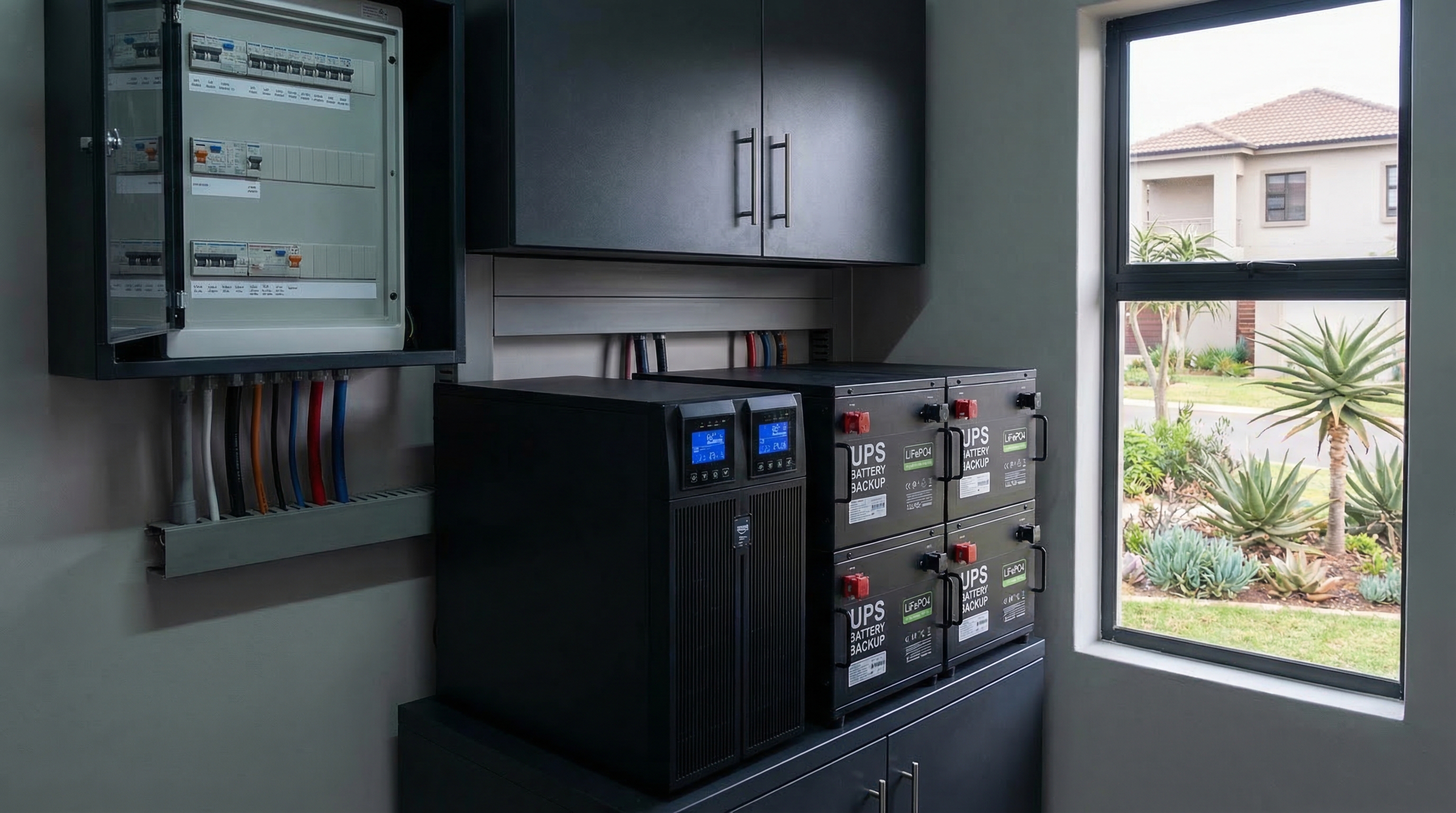
A home inverter system with automatic changeover costs R8,000 to R18,000 installed in Cape Town and will keep your lights, fridge, TV, and router running through a standard 4-hour load shedding slot. ASH Electronics has installed UPS and inverter systems for homes, businesses, and schools across Cape Town since the early 2000s. This guide covers the real differences between UPS and inverter systems, how to size correctly for your needs, battery options, costs, and when solar integration makes sense.
UPS vs Inverter: Understanding the Difference
The terms UPS and inverter are often used interchangeably, but they describe different technologies with different strengths. Choosing the wrong one for your situation is one of the most common and costly mistakes Cape Town property owners make.
- UPS (Uninterruptible Power Supply): A UPS provides instant, seamless power backup - the switch from mains to battery is virtually instantaneous (typically under 10 milliseconds). This makes a UPS essential for equipment that cannot tolerate even a brief power interruption: desktop computers, servers, network routers, PBX phone systems, CCTV recorders, and medical equipment. A UPS is primarily a short-duration device - designed to keep equipment running for 15–90 minutes to allow a graceful shutdown or to bridge very short outages. It also conditions the power supply, protecting equipment from voltage spikes and brownouts even when mains power is present.
- Inverter / inverter-battery system: An inverter converts DC power from a battery bank into AC power that your household or office appliances can use. Unlike a UPS, there is typically a brief switchover time (0.5–2 seconds) when mains power is lost. This makes inverters less suitable for sensitive computing equipment unless they include a built-in UPS-grade switchover. However, inverters are designed for longer runtimes - with a correctly sized battery bank, an inverter can power lights, fans, a TV, a fridge, and phone chargers for 4–12 hours through a single load shedding slot. Modern inverter-charger units (such as Victron, Axpert, and Mecer) combine the inverter and battery charger in one unit and are the most practical load shedding solution for most South African homes.
- Hybrid solar inverter: A hybrid inverter combines an inverter, battery charger, and solar charge controller in one unit. When solar panels are connected, the system prioritises solar power, then battery, then mains - potentially eliminating your electricity bill during daylight hours and providing backup power during load shedding around the clock. ASH Electronics installs hybrid solar systems as a full solution (see our solar solutions page).
How to Size a UPS or Inverter for Your Needs
Incorrect sizing is the most common technical mistake in DIY and poorly installed systems. An undersized inverter will trip under load or fail prematurely; an oversized system wastes money. Here is how to approach sizing correctly:
- Step 1 - List the appliances you want to power: Be specific. A desktop PC may draw 150W; a fridge compressor draws 200–400W at startup; LED lights draw 10W each; a 65-inch TV draws 80–130W. Add up the total wattage of everything you want to run simultaneously.
- Step 2 - Add a 25% safety margin: Your inverter's continuous power rating should be at least 25% higher than your calculated load. If you need 800W, choose a 1000VA/1000W inverter minimum.
- Step 3 - Calculate battery capacity: Battery capacity is measured in amp-hours (Ah). Divide your watt requirement by the battery voltage (typically 12V or 24V), then multiply by the desired runtime in hours, then factor in battery depth of discharge (DoD). Example: 500W load for 4 hours on a 24V system: (500 ÷ 24) × 4 = 83.3Ah at 100% DoD. For lithium batteries (80% DoD), you need 104Ah. For sealed lead-acid (50% DoD), you need 167Ah.
- Step 4 - Choose your battery chemistry: Lead-acid batteries are cheaper upfront but heavier, larger, require ventilation, and have a shorter cycle life. Lithium Iron Phosphate (LiFePO4) batteries are more expensive but lighter, have 3–5x more cycle life, can be discharged more deeply, and are maintenance-free. For most Cape Town residential applications in 2025, lithium is the better long-term investment.
Automatic Changeover: Essential for Hands-Free Protection
An automatic changeover switch (ATS) is what allows your backup power system to switch seamlessly between mains and inverter power without requiring you to flip a switch every time load shedding starts. Without an ATS, you have to manually unplug appliances and plug them into the inverter - defeating much of the convenience. ASH Electronics installs automatic changeover switches as part of every inverter installation. The changeover switch is wired by a qualified electrician into your DB board, designating specific circuits (e.g., lights, TV, internet router, fridge) to be backed up. When load shedding begins, those circuits automatically switch to inverter power within seconds.
Battery Types and Expected Lifespan
- Sealed Lead-Acid (SLA/VRLA): Lifespan of 2–4 years with daily cycling. Inexpensive but heavy and sensitive to overcharging. Best suited to occasional-use UPS applications rather than daily load shedding.
- Gel batteries: Similar chemistry to SLA but with a gel electrolyte - slightly more tolerant of partial state-of-charge but similar lifespan. Commonly found in older UPS systems.
- AGM (Absorbed Glass Mat): Better than standard SLA for cyclic use. Lifespan of 3–5 years with moderate cycling. A reasonable middle-ground option for moderate load shedding use.
- LiFePO4 (Lithium Iron Phosphate): 2,000–6,000 cycles at 80% DoD, equating to 5–15 years of daily use under Cape Town's load shedding schedule. Can be discharged more deeply, weighs 70% less than lead-acid, and does not require ventilation. The premium purchase price is typically recovered within 3–5 years compared to replacing lead-acid batteries every 2–3 years.
- Lithium NMC: Higher energy density than LiFePO4 but less thermally stable. Found in some imported lithium-ion battery packs. We recommend LiFePO4 as the safer chemistry for residential and commercial installations.
Solar Integration: The Next Step After an Inverter
Many Cape Town homeowners and businesses start with an inverter-battery system to handle load shedding, then add solar panels as the next step. Cape Town's 300+ annual sunshine days make solar an excellent investment. A hybrid solar inverter with a battery bank can: charge your batteries from solar during the day, power your home from solar and battery at night, feed excess solar energy back to the grid (with City of Cape Town's Small Scale Embedded Generation tariff), and reduce your electricity bill by 40–80% depending on your system size and consumption profile. ASH Electronics installs complete solar-plus-storage systems and can upgrade existing inverter installations to include solar panels.
UPS and Inverter Installation Costs in Cape Town (2025)
- Basic desktop UPS (600VA–1500VA, 15–60 min runtime for a PC): R800–R3,500 supplied and installed.
- Home inverter system (1000VA–3000VA with 100Ah AGM battery bank, automatic changeover): R8,000–R18,000.
- Home lithium inverter system (2000VA–5000VA with 100Ah LiFePO4 battery, automatic changeover): R18,000–R35,000.
- Business UPS (3kVA–10kVA for server room or office, runtime 30–120 min): R12,000–R45,000.
- Commercial inverter system (5kVA–10kVA with large battery bank): R30,000–R80,000+.
- All prices are approximate and include professional installation by a qualified electrician. Solar panels, if added, are quoted separately.
Maintenance: Protecting Your Backup Power Investment
A UPS or inverter system that is not maintained is a system waiting to fail at the worst possible moment. ASH Electronics recommends an annual maintenance visit for all backup power installations, which includes: testing battery health and capacity under load, checking connection terminals for corrosion, testing the automatic changeover switch, verifying charger settings are correct for the battery chemistry, updating inverter firmware, and replacing batteries that have fallen below 80% capacity. Lead-acid batteries should typically be replaced every 2–3 years in daily load shedding conditions; lithium batteries can last 8–12 years with proper care.